Make Every Clue Count
Deduction is the art of letting the clues do the talking. You never need to be brilliant; you need to be thorough, and you need to be able to point at the clue that justifies each mark you make.
What deduction really asks of you
In everyday life we jump to conclusions that are probably right. Logic puzzles invite a stricter game. Every statement you write down must follow necessarily from the rules and the clues. "It looks like a 4 goes here" is a starting point; "it must be a 4, because 1, 2, 3, 5 and 6 already appear in this row" is a deduction.
That distinction matters because a single unjustified mark can quietly poison the rest of a solve. You will not notice the error until twenty moves later, when two identical numbers collide and you cannot tell where things went wrong. Learning to justify each step is slower at first and much faster in the end, because you rarely have to unpick your work.
A friendly way to practise is to narrate. Say, or write in the margin, "this square is empty because the clue of 3 cannot reach it." If you cannot finish the sentence, you have found a guess, and that is useful information rather than a failure.
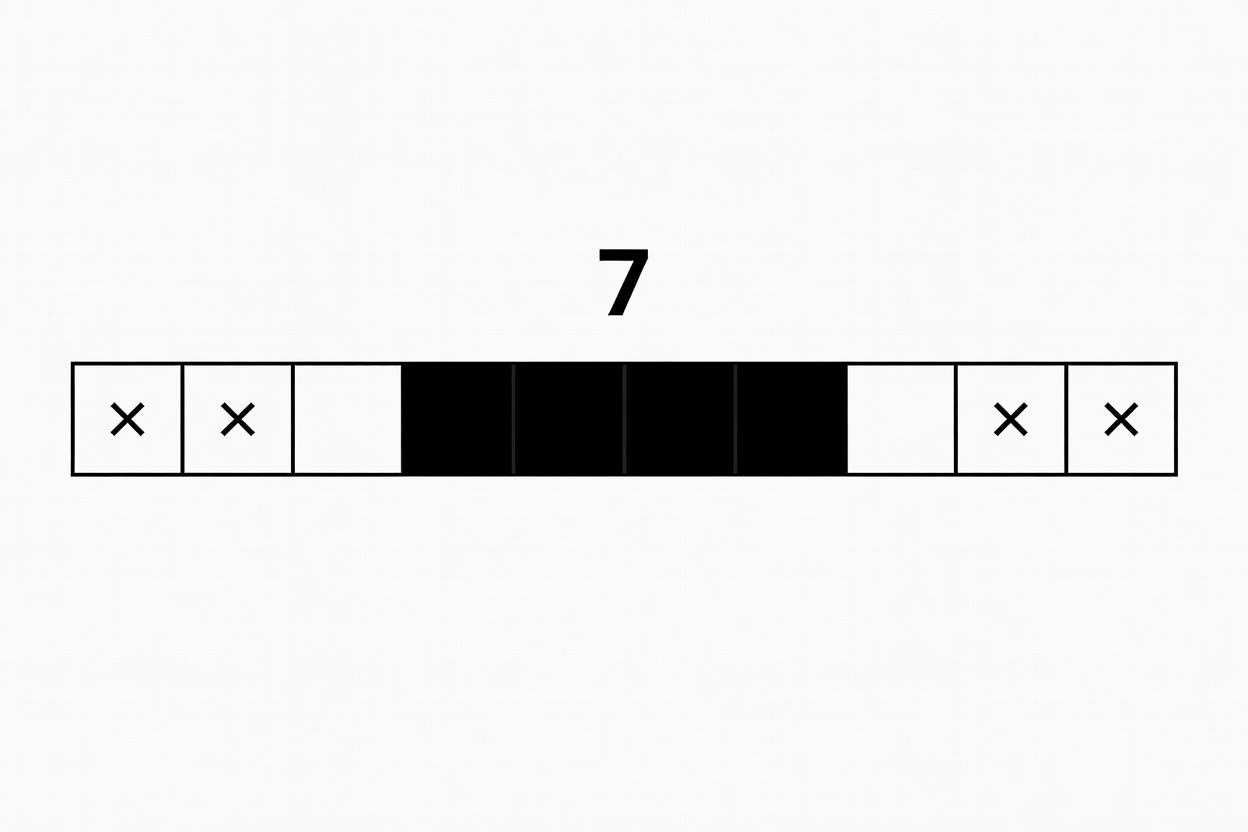
Nonograms: overlap and emptiness
Nonograms were devised independently in 1987 by the Japanese graphic editor Non Ishida and the puzzle maker Tetsuya Nishio, and later became popular in Britain as "Griddlers" through The Sunday Telegraph. Each row and column carries a list of numbers giving the lengths of filled blocks in order. Your job is to colour cells until a picture appears.
The first technique to learn is overlap. Imagine a block of 7 in a row of 10. Push it as far left as it goes: it covers cells 1 to 7. Push it right: it covers 4 to 10. Cells 4 to 7 are covered in both positions, so they must be filled. That is the whole argument, and you can repeat it on every row and column before thinking about anything else.
The second is emptiness. Once a row's blocks are fully placed, every remaining cell is empty. Mark those with a small cross, not just a blank. Crosses are evidence; blanks are uncertainty, and mixing them up is the most common beginner slip.
- Entry: 10×10
- Steady: 15×15
- Stretch: multi-colour
Logic grid puzzles and the Zebra tradition
The puzzle often called the Zebra Puzzle, or Einstein's Puzzle, appeared in Life International in December 1962. Five houses, five nationalities, five drinks, five pets and a list of fifteen clues lead to one question: who owns the zebra? The attribution to Albert Einstein has no reliable evidence behind it, which is itself a nice lesson in checking claims.
The standard tool is a grid that crosses each category with every other. Each clue becomes ticks and crosses. "The Norwegian lives in the first house" is one tick and several crosses. "The coffee drinker lives directly right of the ivory house" is subtler: it rules out the ivory house being last, and coffee being first.
Mark simple "is" and "is not" clues first. Each tick in a row lets you cross every other cell in that row and column of the same sub-grid.
Clues like "directly left of" or "next to" create restrictions at the edges. Write down what positions are impossible before trying to place anything.
If the Spaniard owns the dog, and the dog owner does not drink tea, then the Spaniard does not drink tea. Copy facts across sub-grids every time you learn something new.
Knights and Knaves: reasoning by cases
The logician and magician Raymond Smullyan popularised these riddles in his 1978 book What Is the Name of This Book?. On his island, knights always tell the truth and knaves always lie. You meet some inhabitants, hear what they say, and work out who is who.
The reliable method is the case split. Assume a speaker is a knight and see if everything fits. Then assume they are a knave and check again. Exactly one case should survive.
Exercise: "We are both knaves"
You meet A and B. A says: "We are both knaves." B says nothing. What are they?
Hint
Could a knight ever truthfully say "I am a knave"?
Solution and justification
If A were a knight, the statement would be true, making A a knave. That contradicts the assumption, so A is a knave. A's statement must therefore be false, so it is not true that both are knaves. Since A is a knave, B must be a knight. Every step is forced; nothing was guessed.
Common slips, explained kindly
Treating a blank as a cross
An unmarked cell means "unknown". Use a distinct mark for "proven empty" so your eye does not mislead you later.
Forgetting to transfer
A fact learned in one part of the grid often unlocks another. Pause after each new tick and ask where else it applies.
Stopping at the first contradiction
In a case split, check the other case fully too. A puzzle with no surviving case means an earlier mark was wrong, which is worth knowing.
Places to practise
Simon Tatham's Portable Puzzle Collection: free, open-source logic puzzles, including a nonogram variant called Pattern.
Nikoli: the Japanese publisher behind many classic pencil puzzle genres.