See Another Arrangement
Some people say they "can't do spatial puzzles". Usually they mean they have not yet found a method. Rotation, symmetry and counting are tools anyone can learn, and they turn shape-shuffling into reasoning you can explain.
How mental rotation works
In a well-known 1971 experiment, psychologists Roger Shepard and Jacqueline Metzler showed people pairs of drawn 3D block shapes and asked whether they were the same object turned. The time people took grew steadily with the angle between them, as if they were turning the shape in their minds at a roughly constant speed.
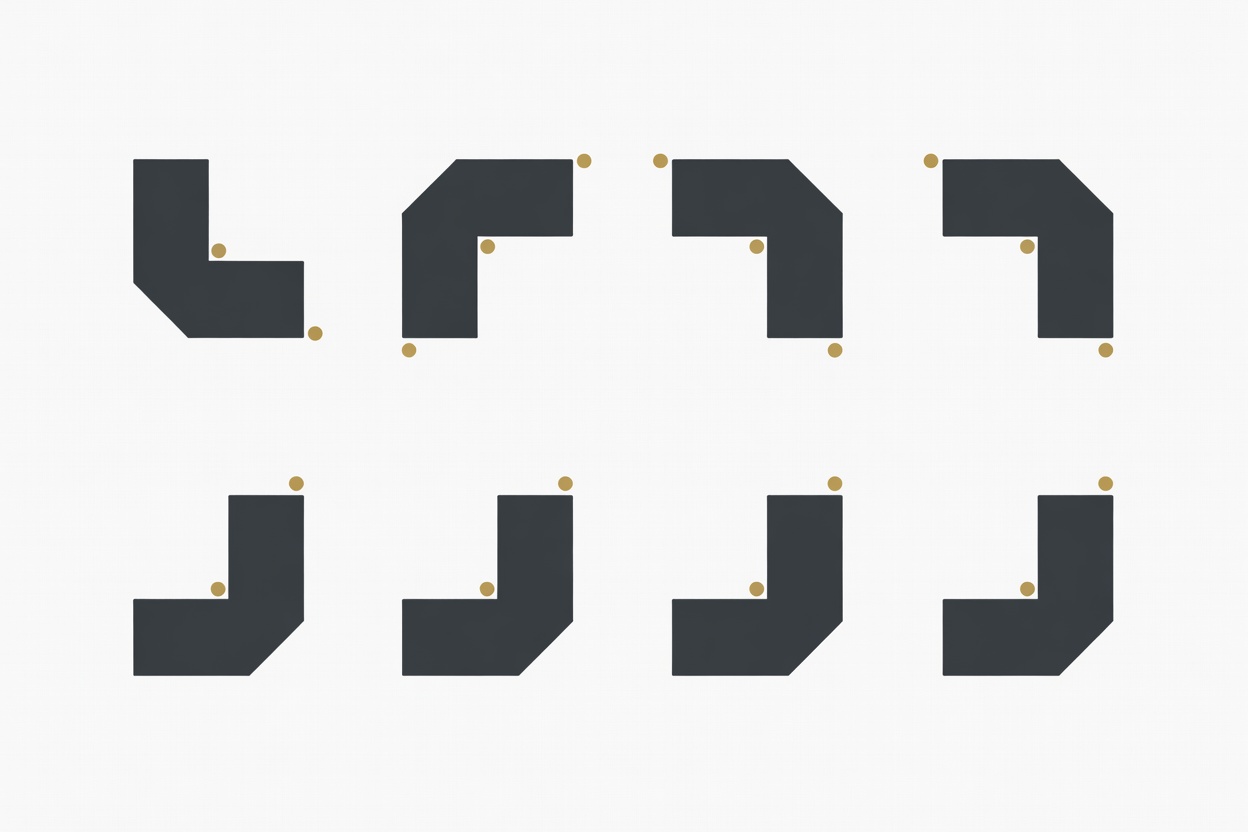
That is reassuring for a beginner. Rotating a shape mentally is not magic; it is a process with steps, and like any process it gets smoother with practice on that kind of task. You can also support it: sketch the shape, mark one distinctive corner with a dot, and track where the dot ends up.
A second helpful idea is the difference between a rotation and a reflection. An L-shape can be turned into many positions, but its mirror image, a J-shape, can only be reached by flipping it over. Many puzzles allow flips; some do not. Always check the rules first.
Flat puzzles: tangrams and pentominoes
Tangram
Seven pieces, called tans, cut from a square: five triangles in three sizes, a square and a parallelogram. The puzzle spread from China through printed books in the early nineteenth century. Every target silhouette must use all seven pieces without overlap.
Reasoning tip: place the two large triangles first. They take up half the area, so where they fit determines almost everything else.
- Entry
- Steady
- Stretch
Pentominoes
The mathematician Solomon Golomb named and studied these twelve shapes, each made from five squares joined edge to edge. Together they cover 60 squares, and there are 2,339 distinct ways to tile a 6×10 rectangle with them, not counting rotations and reflections of the whole board.
Reasoning tip: corners and edges are the tightest spots, so fill them first. The X-shaped piece is the least flexible and is best placed early.
- Entry
- Steady
- Stretch
Three dimensions: the Soma cube and Rubik's Cube
The Danish designer and poet Piet Hein is said to have conceived the Soma cube during a lecture on quantum mechanics. Its seven pieces are all the irregular shapes you can make from three or four cubes. They assemble into a 3×3×3 cube in 240 essentially different ways, and into hundreds of other figures.
Ernő Rubik, a Hungarian architecture lecturer, built his cube in 1974 as a teaching model. It has 43,252,003,274,489,856,000 reachable positions, yet in 2010 a team including Tomas Rokicki and Herbert Kociemba showed that every one can be solved in 20 moves or fewer. Beginners do not need that; they need a method. The common beginner approach solves one layer at a time, with a handful of memorised sequences. The reasoning part is knowing what each sequence changes and what it leaves alone.
The Tower of Hanoi: thinking in smaller copies
The French mathematician Édouard Lucas published this puzzle in 1883. You have three pegs and a stack of discs, largest at the bottom. Move the whole stack to another peg, one disc at a time, never placing a larger disc on a smaller one.
How many moves for three discs?
Hint one
To move the largest disc, the two smaller ones must be stacked on the spare peg first.
Hint two
Moving two discs takes 3 moves. Moving three discs means: move two discs away, move the big one, move two discs back on top.
Solution and justification
3 + 1 + 3 = 7 moves. In general, n discs need 2ⁿ − 1 moves, because each extra disc doubles the work and adds one. You have just used recursion: solving a big problem by solving smaller copies of it.
Spatial reasoning on screen
Tetris
Created by Alexey Pajitnov in 1984 using the seven tetrominoes. Slower game modes let you practise rotation choices without panic.
Portal
Valve's 2007 game asks you to reason about connected spaces and momentum rather than reflexes alone.
Monument Valley
Released by ustwo games in 2014, built around impossible-object geometry in the spirit of M. C. Escher.
The Witness
Jonathan Blow's 2016 game teaches its line-drawing rules wordlessly, rewarding careful observation and hypothesis testing.
These are mentioned as examples of puzzle design, not recommendations to buy. Free physical alternatives work just as well: cut seven tangram pieces from card, or draw pentominoes on squared paper.